Presentation about Lean at Griffith
Today, I gave an informal presentation to the applied maths group at Griffith University about Lean.

Here’s a photo of a koala I saw at Nathan Campus earlier this year. It has a bit of a painterly quality to it because of how much I zoomed in.
I started learning Lean a few months ago after Carlo conducted an AI experiment with one of my previously published papers. Carlo heard the news about the Navier-Stokes Millenium Problem and was curious what AI+Lean could do, so he took my paper plus a recent proof sketch and asked Claude to formalise it all in Lean.
Claude returned after a few hours with about 10,000 lines of Lean code. The good news was that it found no serious errors in my work, and now I apparently have all my proofs verified in Lean. The bad news is that I don’t understand Lean.
So since early October, I’ve been teaching myself using the Lean Community’s textbook Mathematics in Lean. This is a pretty great resource, which alongside a textbook includes exercise templates and worked solutions.
The purpose of my presentation was to share what I’ve learnt so far about Lean.

The first proof I ever wrote in Lean was a proof of the squeeze theorem, which Alex Kontorovich started but left unfinished in this introductory video. This video was an excellent starting point for me, even before starting the exercises in the textbook, because it gave me a clear practical introduction to what Lean is and what it does. I highly recommend it if you’re brand new too.
The first time I completed the proof, I needed a lot of help from Claude. I really recommend working with an AI “tutor”, which also allowed me to discuss some of the mindblowing ideas underlying Lean (e.g., “A proposition is itself a type, and a proof of that proposition is an object of that type”; and “A theorem is a function that converts proofs into proofs”). As I worked through the textbook (I’m currently up to chapter 3), I would intermittently return to the proof with new understanding and ideas to experiment with.
For the presentation, I decided I too would demonstrate how Lean works by doing a live proof of the squeeze theorem. However, I also structured it as though we’re all students trying to figure out the proof in real time. I chose this framing because I was curious if Lean could be used as a teaching tool. In particular, Lean forces the student to step through the process in a rigorous way while providing immediate feedback.
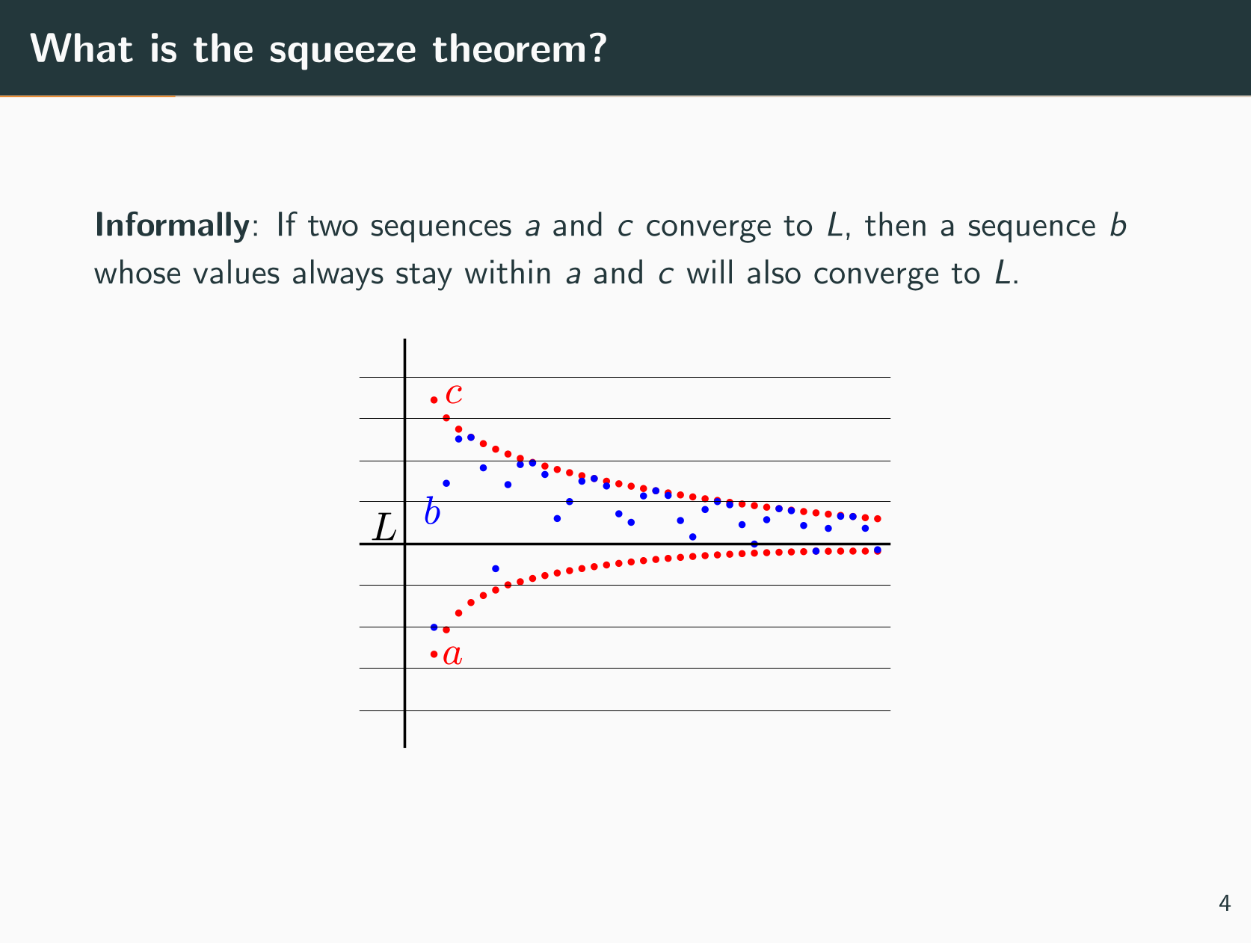
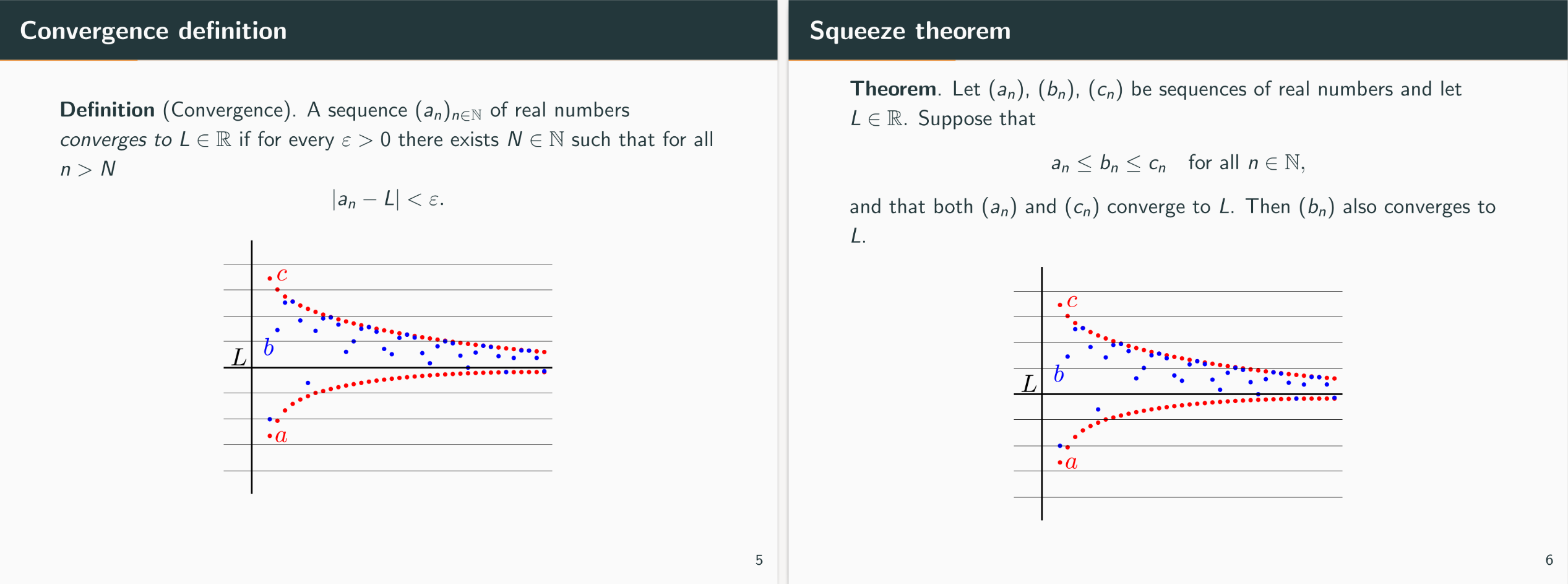
Finding the proof
We began by imagining what we might write on a scrap of paper: a sketch of an example, a quick summary of the definition of convergence and the theorem, and then some working on how to get \(\lvert b_n - L\rvert < \varepsilon\) out of the convergence of \(a\) and \(c\) and the inequality condition.
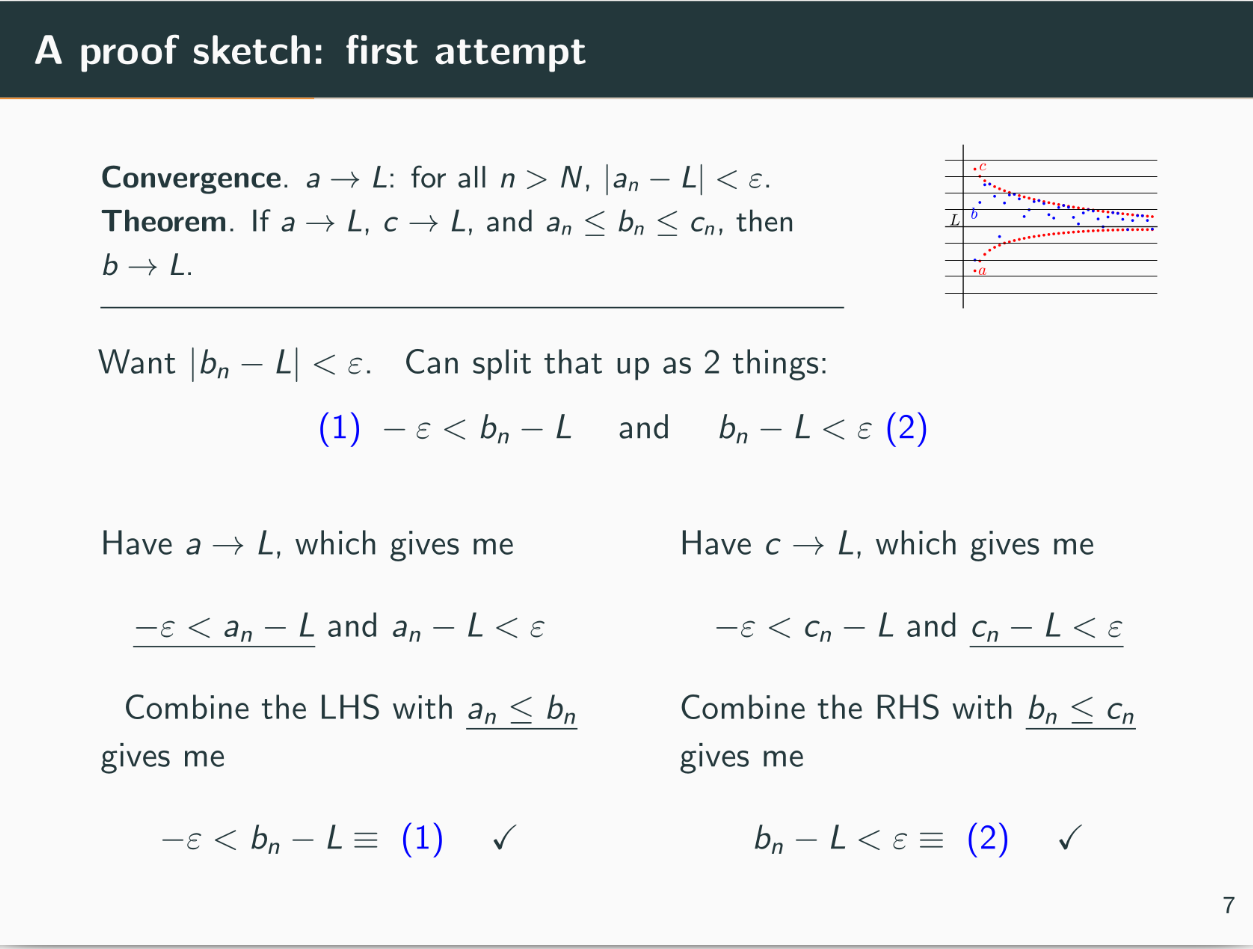
Keen-eyed readers will notice that I’ve made an omission here: I’ve forgotten all about \(N\)! Lean will force us to come back to this, which I thought might have pedagogical value.
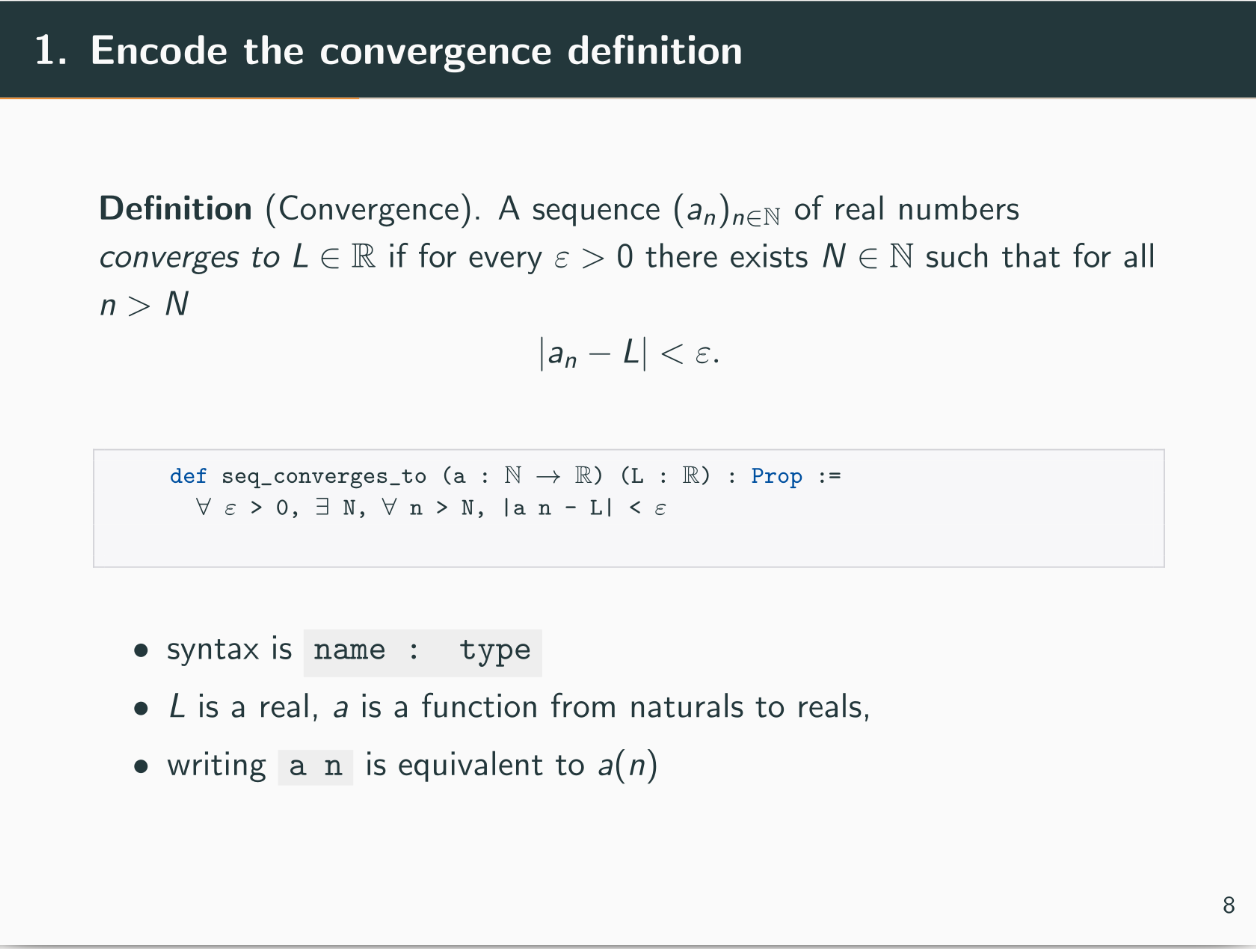
I used the definition of convergence as an opportunity to briefly introduce the syntax and the idea of a type. I couldn’t really do type theory justice, but it was also useful to just pause here on a static slide so everyone could get used to the new syntax.
Then I switched into Lean live to encode the theorem statement.
This was more time to absorb the syntax and now see how maths symbols are written.
I’m used NeoVim, but VSCode works in a similar way,
allowing the user to enter symbols by typing the LaTeX or \ followed by some other
shortcode.
theorem squeeze_theorem (a b c : ℕ → ℝ) (L : ℝ)
  (a_le_b : a ≤ b) (b_le_c : b ≤ c)
  (a_to_L : seq_converges_to a L)
  (c_to_L : seq_converges_to c L) :
  seq_converges_to b L := by
    sorry
After encoding the theorem statement,
I followed similar steps to Kontorovich in the video:
I used unfold to rewrite the goal as
⊢ ∀ ε > 0, ∃ N, ∀ n > N, |b n - L| < ε
We talked about what it means to say “Take an arbitrary \(\varepsilon > 0\)”,
and I showed how intro works.
intro ε ε_pos
Then we hit the \(\exists N\) part of the goal,
and I couldn’t use intro here — we’re meant to do something else.
This was my pedagogical point.
If I am new to the concept of a constructive proof,
for example, then getting stuck here is instructive;
it forces me to return to the problem and think again
about just what it is that we’re trying to prove.
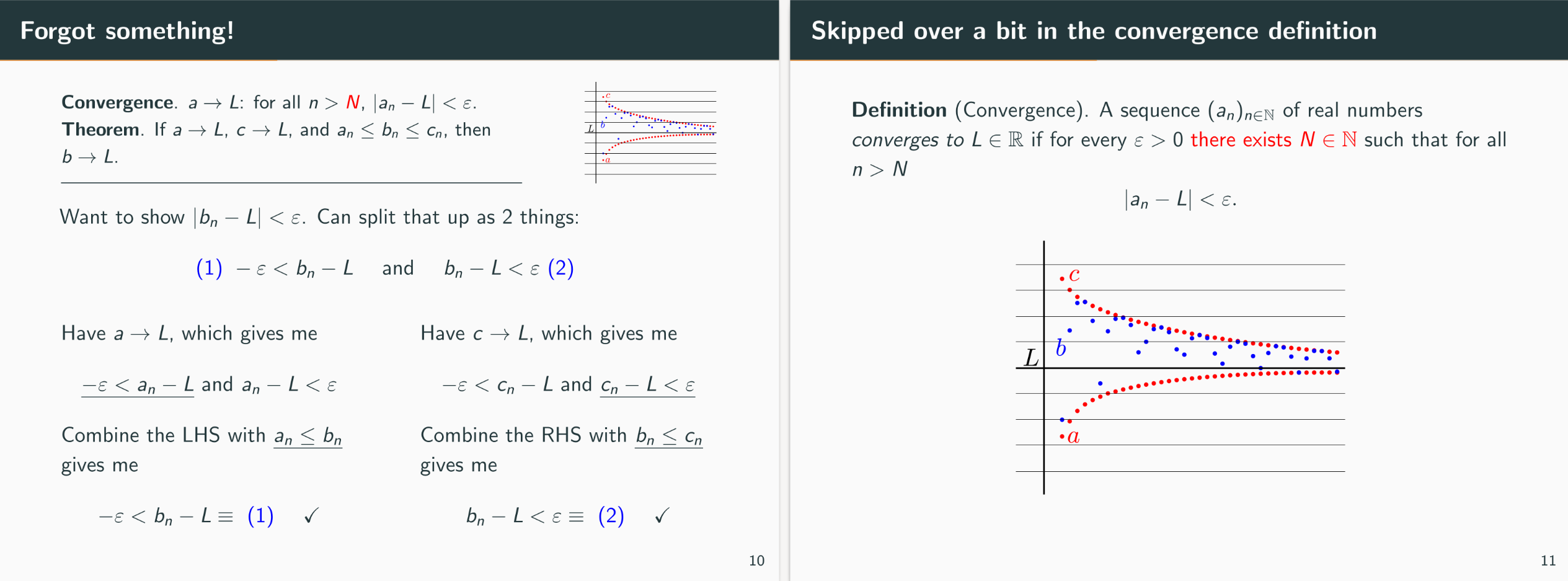
In this case — to prove that \(N\) exists — we need to supply an \(N\) that works. In particular, we need to choose a value of \(N\) that allows use to make use of \(a \rightarrow L\) and \(c \rightarrow L\), as done in the proof sketch.
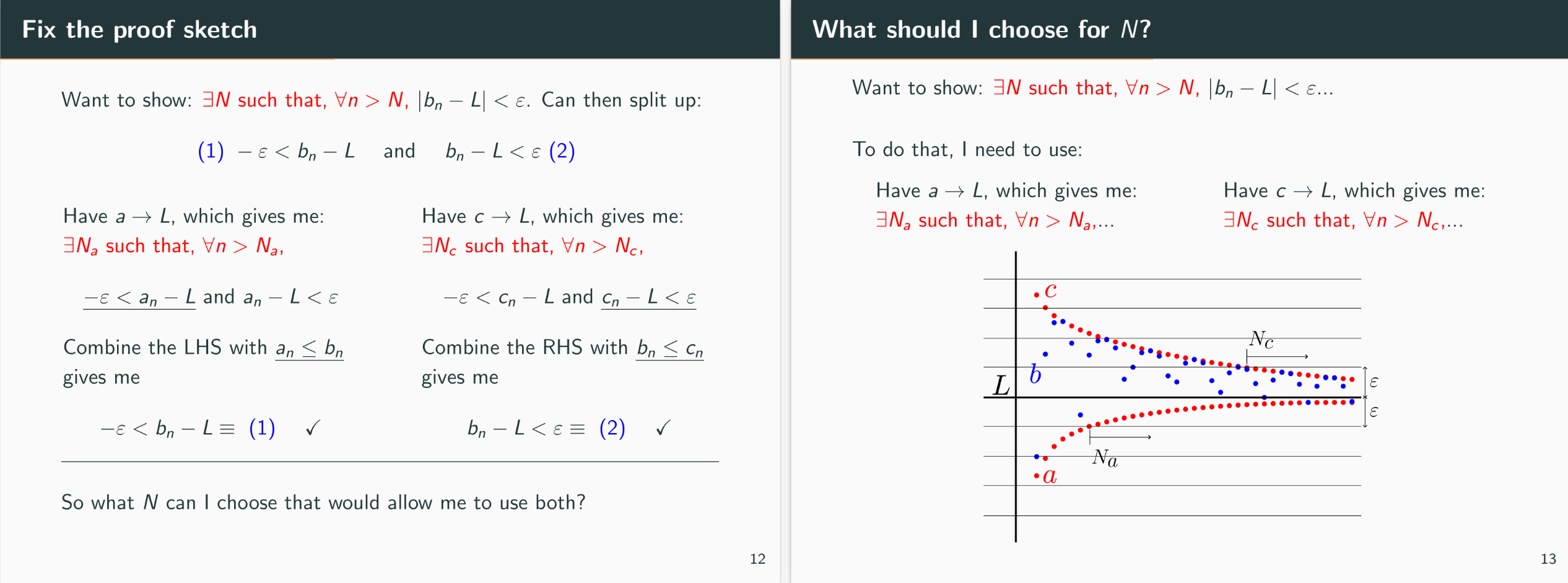
After a bit of discussion, we decided that we should choose \(N := \max(N_a, N_c)\).
The obtain lines were an opportunity to show one way to work with a hypothesis.
To define \(N := \max(N_a, N_c)\),
we need to extract the \(N_a\) and \(N_c\) (the witnesses) out of a_to_L and c_to_L.
I have in my hand an arbitrary \(\varepsilon > 0\),
so I pass it to each hypothesis,
and they give me their witness-proof pairs:
    obtain ⟨Na, hNa⟩ := a_to_L ε ε_pos -- Na : ℕ; hNa : ∀ n > Na, |a n - L| < ε
    obtain ⟨Nc, hNc⟩ := c_to_L ε ε_pos -- Nc : ℕ; hNc : ∀ n > Nc, |c n - L| < ε
Now we I can define and supply our \(N\)
let N : ℕ := max Na Nc
use N
We passed the \(\forall n > N\) with intro n n_gt_N like before,
and then we were left with the goal: |b n - L| < ε.
Now was the opportunity to introduce MathLib.
In the proof sketch,
I jumped straight from \(\lvert b_n - L\rvert < \varepsilon\) to the two inequalities.
Straightforward maths facts like that exist as theorems in Mathlib.
In this case, I want to make use of the theorem called abs_lt.
We checked its definition with #check abs_lt,
and then we made use of it with apply:
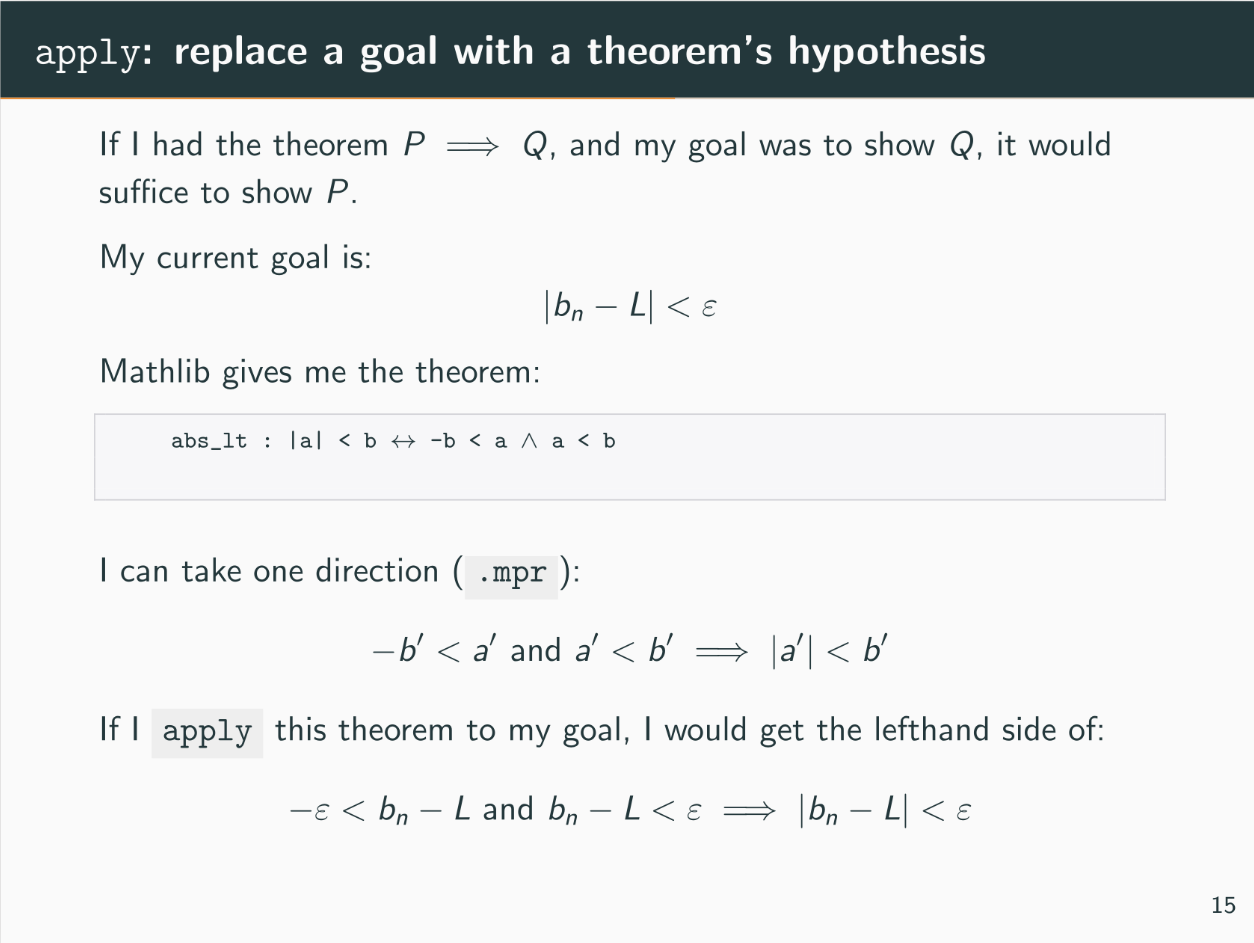
apply abs_lt.mpr
We can now split the goal into two subgoals, which I did with refine and bullet points.
I left a sorry for each subgoal,
which I explained is like an “I owe you” to Lean that I will put the proof there later.
At this point,
the code looked like this:
#check abs_lt -- |a| < b ↔ -b < a ∧ a < b
theorem squeeze_theorem (a b c : ℕ → ℝ) (L : ℝ)
  (a_le_b : a ≤ b) (b_le_c : b ≤ c)
  (a_to_L : seq_converges_to a L)
  (c_to_L : seq_converges_to c L) :
  seq_converges_to b L := by
    unfold seq_converges_to
    intro ε ε_pos
    obtain ⟨Na, hNa⟩ := a_to_L ε ε_pos -- Na : ℕ; hNa : ∀ n > Na, |a n - L| < ε
    obtain ⟨Nc, hNc⟩ := c_to_L ε ε_pos -- Nc : ℕ; hNc : ∀ n > Nc, |c n - L| < ε
    -- the N that will work for both is N = max(Na, Nc)
    let N : ℕ := max Na Nc
    use N
    intro n n_gt_N
    -- SPLIT GOAL into two goals to prove
    apply abs_lt.mpr
    refine ⟨?_, ?_⟩
    · sorry -- ⊢ -ε < b n - L
    · sorry -- ⊢ b n - L < ε
To save time, I decided to demonstrate only the lefthand branch,
i.e., show that -ε < b n - L.
We recalled what our plan was from proof sketch:
combine \(-\varepsilon < a_n - L\) (from $a \rightarrow L$)
with \(a_n \leq b_n\) (given) to obtain \(-\varepsilon < b_n - L\).
The first fact, \(-\varepsilon < a_n - L\), is inside the hypothesis hNa.
To get to it, we need to step past \(n > N_a\).
In other words,
we need to show that the n we have in our hands (from the line intro n n_gt_N)
satisfies \(n > N_a\).
Indeed, that should be the case because that’s why we chose \(N := \max(N_a, N_c)\).
After a bit of pen and paper work, we see why \(n > N_a\) is true, and we can tell Lean by applying a transitivity theorem:
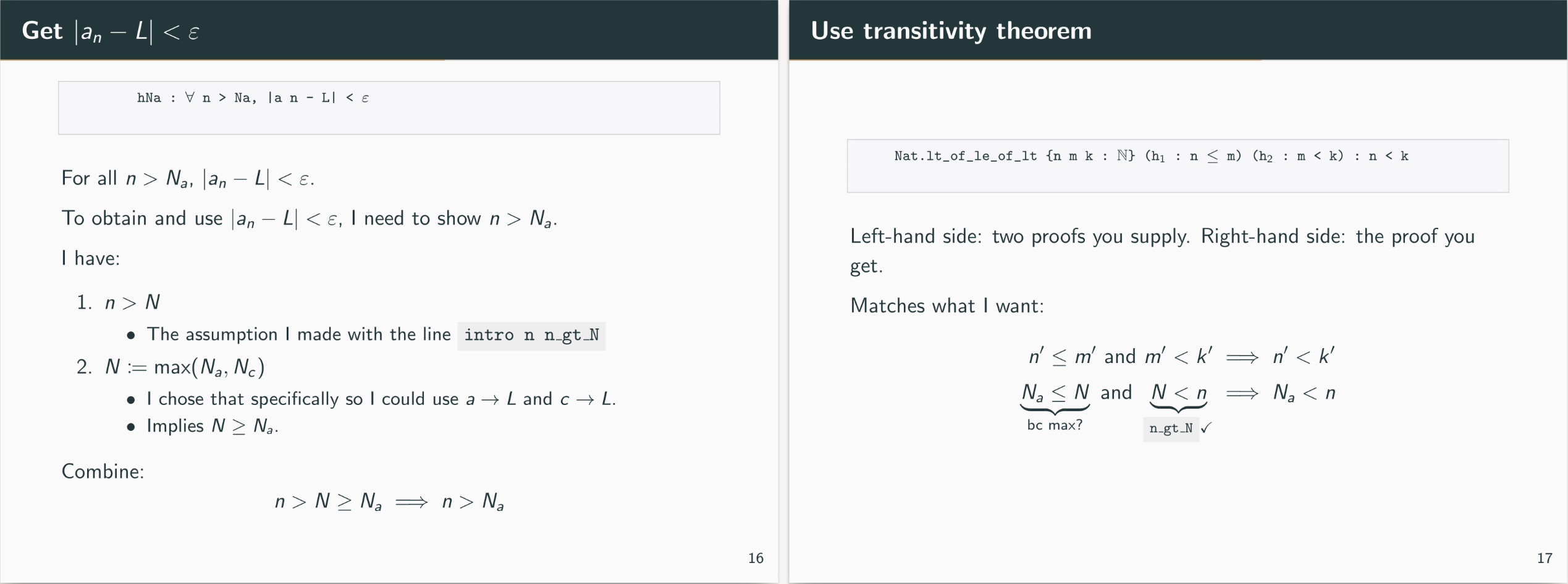
Here was an opportunity to demonstrate another practical use of sorry.
I know that \(N \geq N_a\) because it’s the maximum,
but maybe I don’t know what the name of that MathLib theorem is.
So I put in a placeholder sorry to return to later.
    have n_gt_Na : n > Na := by
      have N_ge_Na : N ≥ Na := by
        sorry
      exact Nat.lt_of_le_of_lt N_ge_Na n_gt_N
The Infoview told me the structure above worked,
so I returned to the sorry,
and I showed them the handy use of apply?.
When I replaced the sorry with apply?,
Lean told me exactly what I needed to complete that proof:
Try this:
  [apply] exact Nat.le_max_left Na Nc
So I copied and pasted exact Nat.le_max_left Na Nc in the place of sorry,
verified that it worked,
and we could move on.
With n_gt_Na (\(n > N_a\)) in hand,
we could now extract the fact \(-\varepsilon < a_n - L\) from hNa.
This provided another example some of the moves we’d just seen: the use of have,
using a hypothesis hNa, another use of obtain, and another use of abs_lt
but this time in the forwards direction.
    have ha : |a n - L| < ε := by
      exact hNa n n_gt_Na
    obtain ⟨ha_left, ha_right⟩ := abs_lt.mp ha -- ha_left : -ε < a n - L
The proof sketch idea was to combine the \(-\varepsilon < a_n - L\) above with with \(a_n \leq b_n\), which I gave with one line:
have a_le_b_n : a n ≤ b n := by exact a_le_b n
The explanation is that Mathlib defines \(\leq\) on functions pointwise,
so a ≤ b means \(\forall n, a_n \leq b_n\).
By supplying n, I obtain the inequality at the point n.
The final step was to combine \(-\varepsilon < a_n - L\) with \(a_n \leq b_n\)
to obtain \(-\varepsilon < b_n - L\).
This was an opportunity to explain that,
although we could do this step-by-step,
Lean also has tactics like linarith that can deal with routine operations.
I replaced the sorry in the first bullet with:
    refine ⟨?_, ?_⟩
    · linarith [ha_left, a_le_b_n] -- ⊢ -ε < b n - L
    · sorry -- ⊢ b n - L < ε
and the left-hand subgoal was completed.
I could have left out the [ha_left, a_le_b_n] part of that line
because linarith uses all hypotheses in its context,
but I thought it was helpful documentation.
From Lean code to human proof
The final thing I wanted to show with the audience was that formalising a proof in Lean can make it easier to write the manuscript version of a proof clearly and rigorously. To do so, we can go through each line of our Lean code and translate it into English.
Proof.
    unfold seq_converges_to
    intro ε ε_pos
    -- ⊢ ∃ N, ∀ n > N, |b n - L| < ε
Let \(\varepsilon > 0\). We must find \(N \in \mathbb{N}\) such that \(\lvert b_n - L\rvert < \varepsilon\) for all \(n > N\).
    obtain ⟨Na, hNa⟩ := a_to_L ε ε_pos -- Na : ℕ; hNa : ∀ n > Na, |a n - L| < ε
    obtain ⟨Nc, hNc⟩ := c_to_L ε ε_pos -- Nc : ℕ; hNc : ∀ n > Nc, |c n - L| < ε
    -- the N that will work for both is N = max(Na, Nc)
    let N : ℕ := max Na Nc
    use N
Choosing \(N\). Since \((a_n)\) converges to \(L\), there is some \(N_a \in \mathbb{N}\) such that
\[\lvert a_n - L\rvert < \varepsilon \quad \text{for all } n > N_a. \tag{1}\]Similarly, since \((c_n)\) converges to \(L\), there is some \(N_c \in \mathbb{N}\) such that
\[\lvert c_n - L\rvert < \varepsilon \quad \text{for all } n > N_c. \tag{2}\]We need a single \(N\) that works for both sequences, so we take
\[N := \max(N_a, N_c).\] intro n n_gt_N
have n_gt_Na : n > Na := by
have N_ge_Na : N ≥ Na := by
exact Nat.le_max_left Na Nc
exact Nat.lt_of_le_of_lt N_ge_Na n_gt_N
Checking that \(N\) works. Let \(n > N\). Since \(N = \max(N_a, N_c)\), then \(N \geq N_a\), and we have
\[n > N \geq N_a,\]so \(n > N_a\).
    have n_gt_Nc : n > Nc := by
      exact Nat.lt_of_le_of_lt (Nat.le_max_right Na Nc) n_gt_N
In the same way, \(n > N \geq N_c\), so \(n > N_c\).
    have ha : |a n - L| < ε := by
      exact hNa n n_gt_Na
Because \(n > N_a\), inequality (1) gives \(\lvert a_n - L\rvert < \varepsilon\).
obtain ⟨ha_left, ha_right⟩ := abs_lt.mp ha -- ha_left : -ε < a n - L
Recall that for real numbers \(x\) and \(y\), \(\lvert x\rvert < y \iff -y < x \text{ and } x < y\). Applying this to \(\lvert a_n - L\rvert < \varepsilon\), we get in particular
\[-\varepsilon < a_n - L. \tag{3}\] have hc : |c n - L| < ε := by
exact hNc n n_gt_Nc
obtain ⟨hc_left, hc_right⟩ := abs_lt.mp hc -- hc_right : c n - L < ε
Likewise, because \(n > N_c\), inequality (2) gives \(\lvert c_n - L\rvert < \varepsilon\), and therefore
\[c_n - L < \varepsilon. \tag{4}\] have a_le_b_n : a n ≤ b n := by exact a_le_b n
have b_le_c_n : b n ≤ c n := by exact b_le_c n
apply abs_lt.mpr
refine ⟨?_, ?_⟩
· linarith [ha_left, a_le_b_n] -- ⊢ -ε < b n - L
· linarith [hc_right, b_le_c_n] -- ⊢ b n - L < ε
Bounding \(b_n - L\). Using the same characterisation of absolute value, showing \(\lvert b_n - L\rvert < \varepsilon\) is equivalent to showing that
\[-\varepsilon < b_n - L \quad \text{and} \quad b_n - L < \varepsilon.\]For the lower bound, combining \(-\varepsilon < a_n - L\) (3) with \(a_n \le b_n\) gives
\[-\varepsilon < a_n - L \le b_n - L.\]For the upper bound, combining \(b_n \le c_n\) with \(c_n - L < \varepsilon\) (4) gives
\[b_n - L \le c_n - L < \varepsilon.\]Together these give \(-\varepsilon < b_n - L < \varepsilon\), that is, \(\lvert b_n - L\rvert < \varepsilon\).
Since \(n > N\) was arbitrary, \(\lvert b_n - L\rvert < \varepsilon\) holds for all \(n > N\). Since \(\varepsilon > 0\) was arbitrary, \((b_n)\) converges to \(L\).
Learning value?
I asked the audience members who were seeing Lean for the first time whether they thought this would be a good learning tool, and the response was generally negative. The consensus was that this was definitely not useful for undergrads, particularly not for those with no coding experience. We remembered what it was like when we ourselves were first learning how to code, how even small syntax errors could cause hours of struggle and confusion. Plus the the cognitive load of learning maths and this peculiar new language at the same time would just be too much.
Some audience members pointed out that the user has to be highly motivated to persist with this. I agreed that I personally have a strong motivation to do this, so that might be why I feel like I have been getting so much out of it. They agreed there was a lot that could be learnt this way, and in a great deal of depth, but some proportion of students in every subject are not interested in that subject in particular, it is simply a step on their way to where they want to go. I agree that’s valid, and this depth of learning is overkill for those students.
So perhaps it could be a useful pedagogical tool for an enthusiastic late-course student or for HDRs, but it is probably a learning tool best suited for self-directed learning.